![]() |
| The Book Coaching Trouble Shooting Seminars Praise FREE Chapter Online Sources |
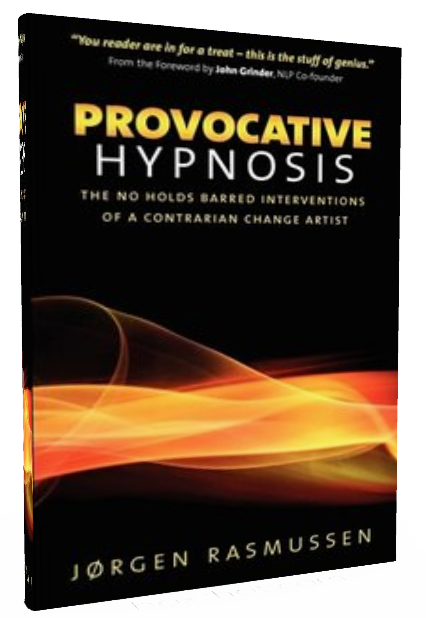
OUTRAGEOUS ACTUAL CASE STORIES AND NEVER BEFORE PUBLISHED NLP AND HYPNOSIS TECHNIQUES AWAITS YOU IN THIS BRAND NEW BOOK. WHY YOU CAN GREATLY BENEFIT FROM THIS BOOK... Let's start with John Grinder NLP cofounder and his foreword: You reader are in for a treat - this is the stuff of genius. Take a young man, unencumbered with theory, with excellent sensory acuity and great flexibility and give him a set of patterns - some mix of the classic and New Code NLP patterning - and set him loose. Oh yeah, it helps enormously that he is fearless - that is, the issue of failure is not part of the baggage he brings to the game, and that he has a healthy disrespect for conventional treatments. Ready for some more praise from people who make their living transforming lives and are well known for their competence and skill?
To read a fascinating chapter from the book, read this free case study about Frank the Multiphobic.
IF THIS IS YOUR FIRST TIME ON THIS SITE AND YOU ORDER TODAY YOU WILL GET THE CHANCE TO ASK JORGEN RASMUSSEN 2 QUESTIONS ABOUT ANYTHING RELATED TO THE BOOK FREE OF CHARGE. Now you should have a good idea of WHAT this book is about. You might be wondering, what about never before published NLP and hypnotic techniques? You will discover them as you learn how to ...
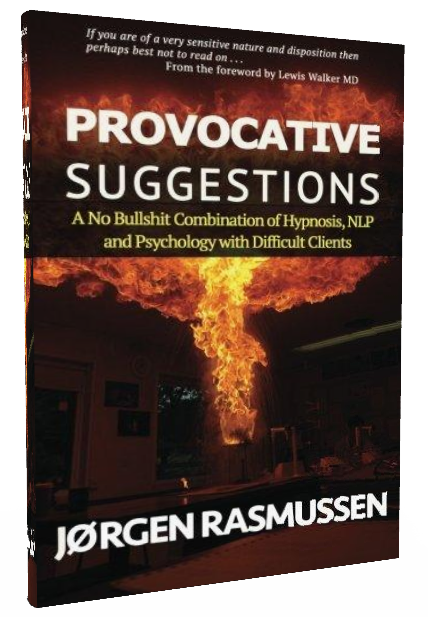
I have designed a question / answer format below to give you a detailed idea of how the book is structured... here goes. A. How did this book come about and why do you think that this book is a unique contribution to anyone interested in personal growth and change work? A few years ago I noticed a disturbing trend in almost all the books and courses I had been ( we are talking hundreds of books and ten years of attending seminars) about NLP, hypnosis and personal change. Quite simply, the books are generally full of success stories and "miraculous claims", but there is very little information about what to do when your techniques don't work. Furthermore ( especially in the NLP and Ericksonian communities) there is a bizarre culture of not admitting to failures . As a result of this its easy to get perfectionistic and the teachers don't help the students see how they made mistakes and LEARNED FROM THEM. i THOUGHT TO MYSELF; where is a good troubleshooting book that's not only free from political correctness , glib superficiality and claims of always succeeding , but where author admits to screwing up and tells you how he used the "screw ups " to get better.. Then I realized that I was the one to write such a book ( as if there really is such a thing , but bear with me ). For close to a decade I worked under a "no change no pay" policy. that meant ( in addition to doing a LOT of free work) that I only got paid when the client got the results they were looking for. This also pretty much forced me to acknowledge and learn from my mistakes . I also deliberately sought out clients who hadn't succeeded using traditional therapy and who had tried "everything"( yes , I did a lot of free work). Of course , even when I didn't deliberately seek out this group of clients I often got them anyways since few went to me first.. This is a very rare platform to stand on. I quickly discovered that ( especially in the NLP community) that most teachers aren't really out there really rockin'n'rollin. they have usually invested in expensive courses and to pay of their investment they tend to start their own training company pretty quickly (that's where most of the money is to be made). To be able to compete in the market they need to pretend to be some sort of "master" ( imagine a gymnast or martial artist claiming to be a master after attending a 24 day long course ). The result being people with very little experience telling other peoples stories. Then their students start doing the same thing to pay of their investment. That's why I claim that no matter what background you have formal or not ... I , as a result of the path I have taken , have something to teach you. Now , its not the "truth" and great information wont replace what you already have that works well, but my stuff will help you enhance your results. REMEMBER, it didn't matter to me ... anorectics, cancer clients, suicidals, neurotics, insomniacs, addicts, pr athletes and musicians. I went for it with congruence. The result of all this experimentation is this book. So, it's a troubleshooting book for the professional that not only covers a lot of "what the hell do I do now" options , but also presents some never published formats. Some of these I have developed myself and others I have gotten from John Grinder. QUESTION: COULD YOU SAY SOME MORE ABOUT HOW THE BOOK IS STRUCTURED. There are four main topics or themes in the book. Interestingly , these are the themes I usually find most lacking in books and courses. 1. The first theme is about framing and creating a learning context for change/ how to frame client relationships and roles. Most people learn NLP or hypnosis in a seminar room. often they are not aware that there are a lot of "social psychology factors" that have as much if not more to do with the techniques working than the techniques them selves. Doing change work outside of the seminar room is a very different context. To give you an appreciation of the power of context consider TV shows like the bachelor. Twenty plus women meet a guy in a very competitive setting and after a few day they are all madly in love with the guy. Do you think that the same would happen if they all by themselves med the same guy on a night out or on a blind date. The book goes heavily into HOW you can create contexts and roles / clients relationships that make change as easy as it can be. Furthermore , most agents of change sabotage their work by accepting frames ( like the mental illness and cause and effect frames) that makes change a lot harder than it needs to be. As an example; words are understood in terms of frames and metaphors. If I use a word like THERAPY then other ideas like CURE , PATIENT , ILLNESS and so on have a tendency to fire off in the clients mind and they deeply influence what's going to happen. Imagine if the media had consistently used the word OCCUPATION instead of WAR when describing the spectacle in Iraq. Quite simply , if you accept to work under a certain frame you will be reinforcing that frame and the unspoken assumption behind the frame. the book goes into which frames and combination of frames I have found the most useful to organize and amplify unconscious processes to create change. 2. THE ANALYTICAL LEFT-BRAINERS Here is a little secret for you ( no , nothing to do with the BS notion that the universe is your personal wishing well ). the subjects selected in seminars and books usually have the following four things in common:
The book shows you how to work with these clients and how to not only work with them where they are , but also to develop the skills they are lacking. I think that this topic is the most ignored in NLP and hypnosis literature. 3. NLP AND HYPNOSIS TECHNIQUES AND TROUBLESHOOTING. Here I will show you how to get deep hypnosis with analyticals. I will also teach you when and how to use new code games and formats. There is some good information on how to use ordeals as well as how to work with people where none of the standard techniques work. You will learn how to get better results when using hypnotic age regression as well as how to "new code" it. For those of you familiar with Time line Therapy , you will learn how to radically improve on it as well as correct some it its flaws. You will also get ideas on how to use provocation to elicit responses , how to do hypnosis hijacking , as well as how to do change work outside of the office. 4.HOW TO WORK WITH THE HIGHLY HYPNOTIZABLE. These clients often change easily, but its often easy come easy go. There are benefits and risks to having the capacity to do deep hypnosis . This chapter will teach you about how you can avoid the common pitfalls as well as how you can work with this group of clients to ensure long term results. QUESTION. WHAT ABOUT AFTER I HAVE READ THE BOOK?
|
w w w . p r o v o c a t i v e h y p n o s i s . c o m |